
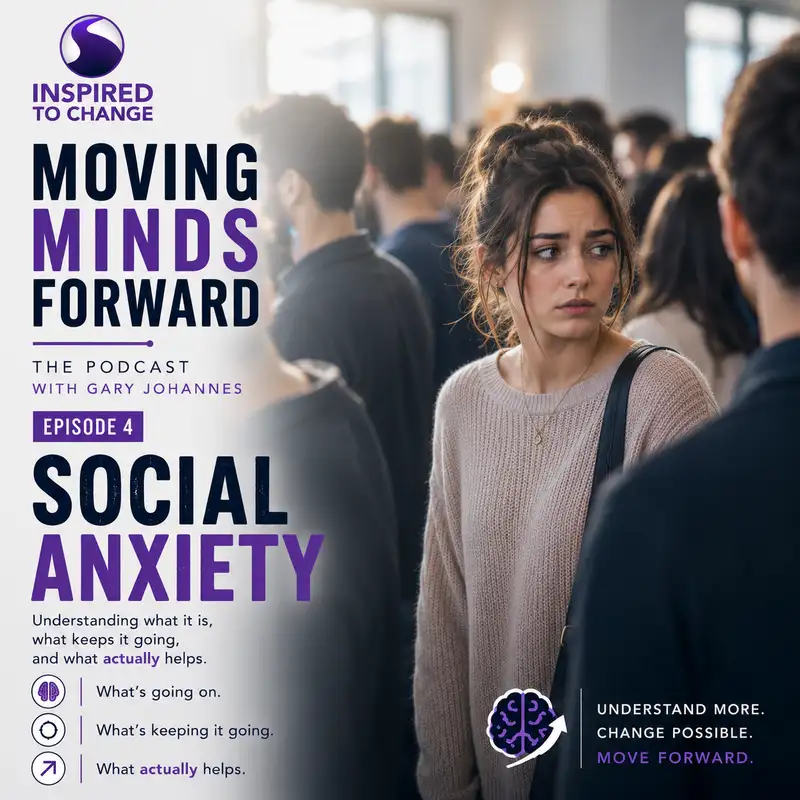
 Episode 4
· 15:05
Hi. My name is Gary Jahanis. I'm a solution focused hypnotherapist, founder of Inspire to Change, and I train other hypnotherapists through CPHT. I left school at 14 with no qualifications. One of nine kids, joined the RAF at 16, then left and went into sales, run bars and nightclubs and restaurants.
Gary Johannes:Not exactly the typical route into mental health. But in my late forties, I met a hypnotherapist, and everything I thought I knew about myself turned out to be a lot more flexible than I assumed. I retrained and started Inspire to Change. I took on an MSc in psychology and neuroscience of mental health at KCL in London, and then graduated at 60. This podcast is everything that comes from all of that.
Gary Johannes:One condition per episode. What's going on? What's keeping it going? And what exactly helps? Let's get into it.
Gary Johannes:So social anxiety. I want to start with something that I think will land with a lot of people listening to this. Most people with social anxiety don't look like they have social anxiety. They show up. They function.
Gary Johannes:They hold conversations. Go to work. Get through the day. From the outside, everything looks fine. But on the inside, before the event, during it, and long after it's over, something very different is happening.
Gary Johannes:The constant monitoring, the self scrutiny, the replaying of everything you said and didn't say, the certainty that you came across wrong, that people noticed, that you embarrassed yourself somehow, the relief when it's over, and then the dread when the next thing comes around. That's what social anxiety actually feels like. Not shyness, not introversion, not just being a bit awkward, something much more specific and much more exhaustive than any of those things. If that sounds familiar, you're in the right place. We're gonna cover what social anxiety actually is, what's happening in your brain when it kicks in, what causes it, what keeps it going, and what actually helps.
Gary Johannes:And I'll leave you with one practical thing you can take away today. And if you find this useful, hit subscribe wherever you're listening. There's a lot more to come. So what is social anxiety, really? It's not just nervousness.
Gary Johannes:Most people feel nervous sometimes. Social anxiety is something more specific than that. It's a feeling that social situations are dangerous, that you're being judged, measured, watched, and that if you get something wrong, say the wrong thing, come across the wrong way, people will think less of you. Clinically, it's deemed as a persistent and intense fear of social situations and social judgment, But lived experience feels far more personal than any definition. It affects the most ordinary things, making a phone call, going to the shopping center, eating in public, walking into a room where people are already seated.
Gary Johannes:Things that people do without a second thought can feel for someone with social anxiety like navigating a minefield. And here's what makes it different from nerves. It's persistent. It's disproportionate, and it's disruptive. People with social anxiety often know, on some level, that the fear isn't entirely rational.
Gary Johannes:They know the presentation probably won't go as badly as they were imagining, but knowing that doesn't make the fear go away. And that gap between what you know and what you feel is one of the most frustrating things about it. Around eight million people in The UK are estimated to struggle with this. It most commonly starts in the teenage years, when social comparison, peer judgment, and the need to belong are at the most intense. But it doesn't stay in adolescence for everyone.
Gary Johannes:For many people, it follows them into adulthood, into workplaces, into relationships, quietly shaping decisions and limiting possibilities for years. So what's happening in the brain? We've talked in earlier episodes about the amygdala, the brain's threat detection system. Social anxiety is essentially that system being triggered not by physical danger, but by social danger. The possibility of rejection, humiliation, being seen as inadequate.
Gary Johannes:The amygdala doesn't distinguish between a predator and a room full of people watching you speak. A threat is a threat. So it responds in the same way. Fight or flight, adrenaline, heart racing, face flushing, mind going blank, which is exactly what you don't want happening in the middle of a presentation or a conversation with someone you're trying to impress. When social anxiety kicks in, attention turns inwards.
Gary Johannes:Instead of focusing on what's happening around you, you're monitoring yourself. How do I look? Does my voice sound strange? Am I making too much eye contact or not enough? What should I say next?
Gary Johannes:That internal monitoring takes up enormous mental bandwidth, which makes it harder to engage, which makes the conversation feel more awkward, which confirms the fear, which increases the anxiety next time. And then afterwards comes the replay. You go over everything, what you said, what you should have said, the look on someone's face, whether you sounded awkward, whether you came across wrong. Social anxiety is very good at turning uncertainty into evidence. That replay can last for hours, sometimes days.
Gary Johannes:It's exhausting, and it sets up the dread for the next time. So what causes it? Usually, a combination of things rather than one single moment or reason. Biology plays a role. Some people's nervous systems are naturally more sensitive and reactive.
Gary Johannes:If anxiety runs in your family, your risk is higher. Early experiences matter. Bullying, humiliation, feeling excluded. The brain learns from those experiences. It learns that social situations can be dangerous.
Gary Johannes:That judgment can come at any time, and it falls our way. And then there's the world we're living in now. Social media and the constant performance of social life, every moment potentially documented and judged, is genuinely significant for people already predisposed to this. It makes the fear of judgment feel very real and very constant. The key thing to understand is this.
Gary Johannes:Social anxiety developed for a reason that made sense at the time. It was the brain trying to protect you. It just got stuck doing that job long after it needed to. So what keeps it going? This is where it really matters.
Gary Johannes:Social anxiety doesn't just happen. It maintains itself through patterns that, unless they're interrupted, tend to make things worse over time, not better. Avoidance is a central one. Every time you avoid the situation that makes you anxious, the party, the meeting, the phone call, you get short term relief, and that relief is real. And the brain notices, but every avoidance also sends a message.
Gary Johannes:That situation was dangerous. What makes it feel more threatening next time? What makes avoidance feel even more necessary? The thing that feels like it's protecting you is keeping you stuck. There's another layer with social anxiety specifically, safety behaviors.
Gary Johannes:These are the things people do to get through social situations without fully avoiding them. Arriving early to avoid walking into a room, staying close to someone you know, checking your phone to avoid eye contact, having a drink to take the edge off. They feel helpful, but they prevent the one experience you actually need, being in that situation and coming through okay. They keep alive the belief that you couldn't have managed without them. Over time, withdrawal, a smaller world, and as a world gets smaller, the confidence to navigate it gets smaller too.
Gary Johannes:Cycle after cycle after cycle. But cycles can be broken. That's what the evidence shows. So what actually helps? The solution focused approach doesn't start with the past.
Gary Johannes:It starts with a different question entirely. What would life look like if social anxiety wasn't running the show? What are you doing? Where are you going? How do you feel walking into a room?
Gary Johannes:What conversations are you having? What are you saying yes to that right now feels completely out of reach? Getting clear on that gives the brain direction, something to move towards rather than something to be stuck in. From there, the work is about interrupting the patterns, keeping the anxiety alive. Avoidance gets addressed gradually, not by throwing yourself in at the deep end, but by reentering situations incrementally, Starting small, building evidence.
Gary Johannes:Each time you go into a situation and come through it, even imperfectly, even awkwardly, you've given your brain new information. That wasn't as dangerous as I thought. I managed. The threat assessment starts to shift. Safety behaviors get reduced one at a time, because the only way to build real confidence is to have real experiences, not relying on protective habits, but actually discovering you can handle the situation.
Gary Johannes:Sleep matters too. Poor sleep amplifies that. Poor sleep amplifies the threat response, makes a self critical voice louder, reduces the capacity to cope. It's part of the foundation and the three pillars. Positive interaction, even small, low stakes moments, builds serotonin and starts to create new associations with social situations.
Gary Johannes:Positive actions build momentum and self belief, and deliberately noticing what went well rather than only what went wrong starts to retrain the post event replay. When social anxiety takes over, life starts to shrink. People stop seeing others, stop engaging, stop showing up, and the brain gets less and less of what it needs, starts to interpret more and more of the world as threatening. So that's where rebuilding starts. Not dramatically, but small things.
Gary Johannes:One conversation, one moment of showing up, one experience of coming through. That's how the brain changes, not in leaps, in small, consistent steps. Before I close, one thing you can do right now. After your next social interaction, any social interaction, however small, notice one thing that went okay. Not a deep breath, not analysis, just one thing.
Gary Johannes:One moment of connection, Something that landed. A conversation that felt natural for a few seconds. Something that made you smart. The post event replay that Social Anxiety creates is almost entirely focused on what went wrong. It's automatic, relentless, and it builds a completely distorted picture of how things actually went.
Gary Johannes:Deliberately looking for one thing that went okay or even something small, starts to retrain that process. It doesn't deny difficult moments happened. It just insist on a more accurate picture. Do that after every situation for the next week. Notice what starts to shift.
Gary Johannes:If you listen if you're listening to this because social anxiety is part of your life, I want you to hear something clearly. Social anxiety isn't a personality flaw. It isn't shyness you should just push through. It isn't evidence that you're not likable or interesting or capable of connection. It's a brain that learned to treat social situations as dangerous.
Gary Johannes:Usually, for a reason that made complete sense at the time, people who have done this work, who felt utterly convinced this was just who they were, found that it wasn't. They weren't bad with people. They had a very anxious brain that had been running the show for too long, and brains can learn something different. The world social anxiety has been shrinking can open back up. One conversation, one moment, one step at a time.
Gary Johannes:See you on the next episode.
Listen to Moving Minds Forward using one of many popular podcasting apps or directories.